
Views: 0 Author: Site Editor Publish Time: 2026-03-04 Origin: Site
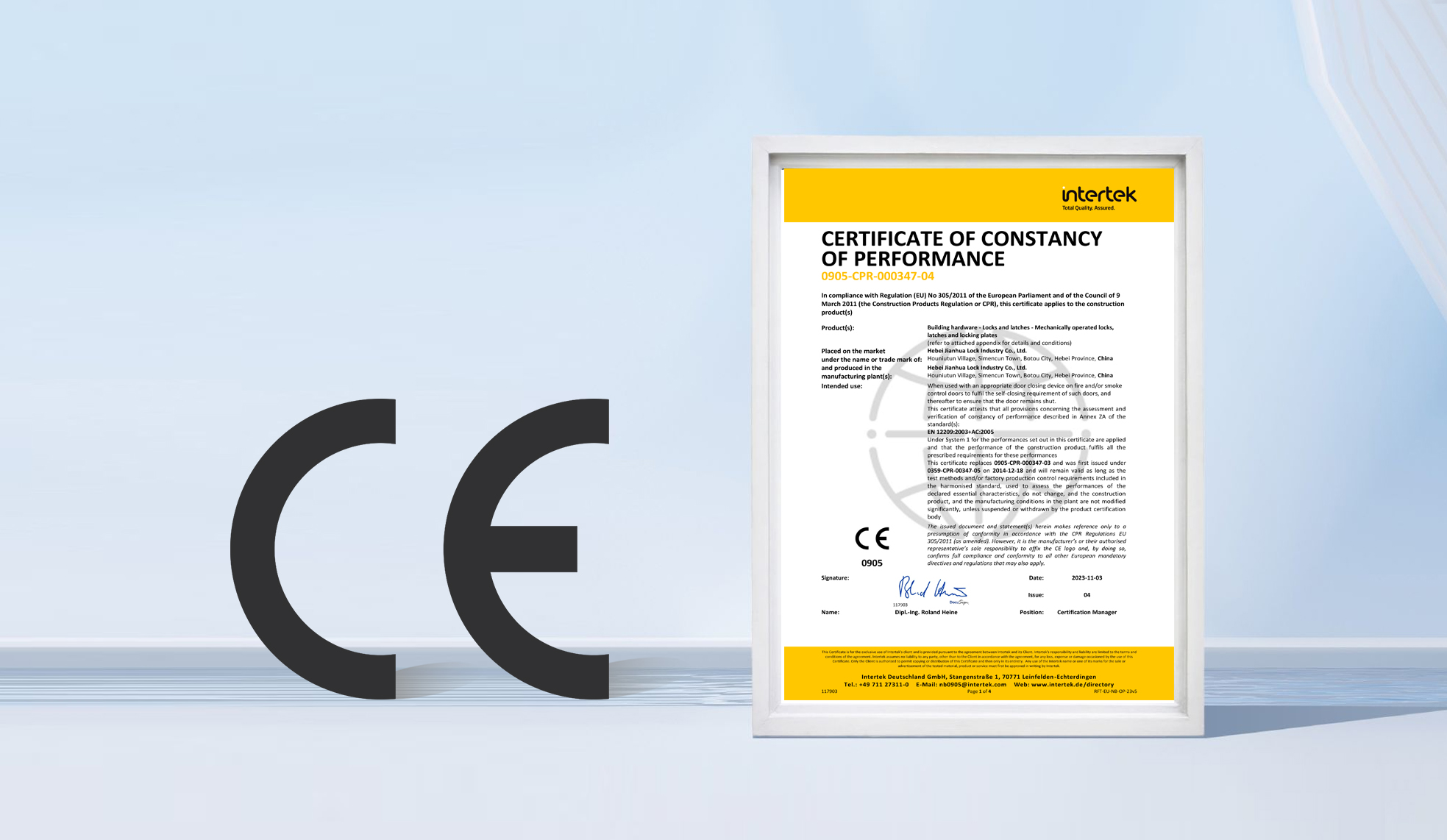
CE certification is the mandatory passport for fire door hardware entering the EU market, but its significance extends far beyond a mere mark. This article outlines the core regulations, key procedures, stakeholder responsibilities, and common misunderstandings of CE certification, providing clear and practical guidance for your reference.
CE certification is a mandatory compliance mark in the EU, not a quality mark. It indicates that a product meets EU regulatory requirements concerning safety, health, and environmental protection.
Affixing the CE mark means the product has undergone conformity assessment and can circulate freely within the EU, the UK, and the European Economic Area (EEA) without requiring repeated approvals in each country — it is the legal "passport" for products entering the European market.
By affixing the CE mark, the manufacturer assumes full compliance responsibility, declaring that the product satisfies all applicable directives, standards, and essential health and safety requirements.
It is important to note: Only product categories covered by specific EU legislation require mandatory CE marking; products not subject to such regulations must not bear the CE mark. For most construction products, CE certification is required for sale in the European market. For construction products covered by harmonised standards or that have obtained a European Technical Assessment (ETA), the CE mark serves as the sole conformity mark, demonstrating compliance with the essential characteristics covered by the harmonised standard or ETA.
The core regulation for CE certification of construction products is Regulation (EU) No 305/2011, the Construction Products Regulation (CPR). This regulation establishes the compliance criteria for construction products entering the EU market, defines the responsibilities of relevant parties, and sets out conformity assessment requirements. It is the fundamental basis for developing harmonised standards, preparing Declarations of Performance (DoP), and affixing the CE mark.
Harmonised European standards (hEN) are technical specifications developed by European standardisation bodies (CEN/CENELEC) to enable a uniform performance assessment of construction products. Continuously optimised by technical experts, they serve as the key technical basis for manufacturers to prepare Declarations of Performance (DoP) and affix the CE mark.
The core function of harmonised standards is to establish a common technical language for the construction industry, unifying methods for assessing product performance and criteria for evaluation. They provide clear criteria for EU regulatory authorities to verify product compliance, technical guidance for manufacturers to declare product performance and for designers and contractors to verify product conformity.
For fire door hardware, key harmonised standards include:
EN 12209:Mechanically operated locks and locking plates — Requirements and test methods
EN 1154:Controlled door closing devices — Requirements and test methods
EN 179: Emergency exit devices operated by a lever handle or push pad, for use on escape routes
— Requirements and test methods
EN1125: Panic exit devices operated by a horizontal bar, for use on escape routes —Requirements and test methods
EN1935: Single-axis hinges — Requirements and test methods
EN 1634-1: Fire resistance test for door and shutter assemblies and openable windows
The Declaration of Performance (DoP) is a mandatory document for CE certification of construction products under the CPR framework. It is drawn up by the manufacturer based on product assessment data, and the manufacturer assumes full legal responsibility for the accuracy of the declared information and the conformity of the product's performance.
For construction products falling within the scope of EU harmonised standards or European Technical Assessments (ETA), manufacturers must prepare a DoP before placing them on the market. Its core content must specify: the intended use of the product; key characteristics and performance levels (such as durability, mechanical strength); information on hazardous substances contained in the product (if any); product model; applicable standard/ETA number; and the AVCP system applied, among other details.
The core value of the DoP lies in transparently communicating the product's key performance information to the market, providing a basis for customer selection, promoting transparency and standardization in the EU construction products market, supervising and encouraging manufacturers to consistently supply stable, reliable products.
For any fire door hardware intended for the EU market, CE certification is a non-negotiable legal requirement. Fire door hardware without CE certification is strictly prohibited from being placed on the market or used in any construction project. Non-compliance can lead to product recalls, substantial fines, and in severe cases, legal liability. Lack of CE certification means direct exclusion from the EU market, making any related business activity impossible.
CE certification is far from a mere formality. It involves rigorous, specific testing — conducted by EU-recognized Notified Bodies—to validate the critical performance of fire door hardware, including mechanical durability, fire resistance, operational functionality under high temperatures, structural stability, and more. This independent third-party verification serves as authoritative proof that the product meets essential safety and performance requirements.
For manufacturers, affixing the CE mark constitutes a formal declaration that the product fully complies with all relevant EU regulations and EN standards, voluntarily assuming full legal responsibility for its compliance and safety. This helps mitigate risks associated with non-compliance, such as legal disputes, financial liability, and damage to brand reputation.
For specifiers, contractors, and building owners, selecting CE-marked fire door hardware provides direct evidence that the chosen products meet European standards, significantly reducing the risk of project rejection during approval processes or facing regulatory penalties later. It enables a mutual benefit situation for both suppliers and buyers regarding compliance.
The CE mark is not a label that can be affixed arbitrarily; it is the final result of a defined series of conformity assessment procedures.
Product and intended use definition: Clarify the intended use of the product, identify the relevant harmonised standards (hEN) in the EU Official Journal, and determine the product's key characteristics and the applicable Assessment and Verification of Constancy of Performance (AVCP) system.
Performance testing and conformity assessment: Conduct the required performance tests (e.g., fire resistance, durability, mechanical strength) according to the relevant standards and the applicable AVCP system. If the AVCP system requires third-party involvement, submit samples to an EU-recognised Notified Body for specific testing (e.g., fire resistance, mechanical tests) and obtain the qualified test reports and certificates.
Technical documentation and declaration of performance: Compile and archive comprehensive technical documentation, including test reports, Factory Production Control (FPC) documentation, product drawings, etc. Draw up the Declaration of Performance (DoP) based on testing and assessment results, assuming full responsibility for the declared product performance. Documents must be retained as required.
CE marking affixing and ongoing compliance: Affix the CE mark to the product or its packaging, and ensure the required compliance documents accompany the product when placed on the market. Subsequently, if significant changes occur to the product design, raw materials, or production process, or if the relevant standards undergo major revisions, the product must be reassessed, and the certification documentation updated to ensure continuous compliance.
UKCA (UK Conformity Assessed) is the product compliance marking established by the UK after leaving the EU, intended to replace the CE mark for products entering the Great Britain market (England, Wales, and Scotland). Its certification logic and testing requirements are similar to CE certification. Currently, the UK government has indefinitely extended the recognition of the CE mark for the Great British market.
Certifire is an independent third-party certification scheme for passive fire protection products, operated by Warringtonfire. It aims to verify product performance, quality, reliability, and traceability in fire conditions. Recognised by numerous regulatory bodies globally, it is an internationally accepted fire safety mark.
UL (Underwriters Laboratories) is a highly authoritative, non-profit, independent private safety testing and certification organisation in the United States. Unlike CE certification, which is mandatory under EU regulations, UL certification is essentially market-driven and voluntary. However, in the North American market, the UL mark has become a de facto standard for product safety and market acceptance.
UL 10C is a specific fire test standard designated by UL for fire door assemblies, used to evaluate the fire integrity and stability of fire doors and their associated hardware in fire conditions. It is a key reference standard adopted by North American building codes and a critical technical requirement for fire door hardware to obtain fire resistance qualifications and market access in North America.
The UK's Approved Document B (Fire Safety) previously operated a dual system, accepting both European standards and traditional British standards for assessing fire performance and classification of construction products. For the fire resistance of doors and hardware, both BS 476 and the European standard EN 1634-1 were used as the basis for compliance.
According to recent UK regulatory updates, the BS 476 series will be phased out from official recognition:
From March 2, 2025: References to BS 476 related to reaction to fire and roofs performance have been withdrawn.
From September 2, 2029: References to BS 476 related to fire resistance will be formally withdrawn. After this date, fire resistance must be tested and classified exclusively according to European standard EN 1634-1.
This change means that construction products targeting the UK market will fully transition to unified European standards in the future, leading to a clearer, more unified certification system that facilitates long-term compliance planning for enterprises.
Bear the core responsibilities, including:
Carrying out the conformity assessment procedures according to the applicable AVCP system, compiling complete technical documentation, drawing up the Declaration of Performance (DoP), and affixing the CE mark as required;
Retaining technical documentation and DoP for at least 10 years from the date the product is placed on the market;
Establishing and maintaining a Factory Production Control (FPC) system to ensure continuous conformity of products with the declared performance;
Providing instructions and safety information in a language easily understood by users in the target market;
Taking immediate corrective measures (including withdrawal or recall) if the products placed on the market are found not to conform to the declaration or regulatory requirements.
Before placing products on the market, the importer must:
Verify that the manufacturer has completed AVCP assessment and verification, that technical documentation and DoP are complete, that the CE mark is properly affixed, and that accompanying documents are complete;
Indicate their own name, trademark, and contact details on the product or packaging;
Conduct sample testing of products already on the market when necessary, record complaints and non-conformities, and promptly notify regulatory authorities;
Verify the validity of certification for purchased products, confirming that products have been affixed with the CE mark as required and accompanied by necessary documents;
Accurately inform customers of the certification scope and must not sell non-compliant products;
Important Note: If an importer or distributor places products on the market under their own name or trademark, or modifies products in a way that may affect their conformity, that importer or distributor is considered the manufacturer and must assume all manufacturer obligations.
Misconception 1: CE Certification is valid for life
Fact: CE certification is a dynamic process requiring ongoing maintenance. Under the CPR and the applicable AVCP system, manufacturers must continuously operate their Factory Production Control (FPC) and conduct periodic testing to ensure batch products consistently meet the performance declared for the tested sample. If changes occur in materials, design, or production process, or if relevant standards undergo a major revision, the product must be reassessed and its certification documentation updated. For products involving a Notified Body, the certification status is maintained through annual surveillance audits.
Misconception 2: The CE mark is a quality mark, indicating a "Better" product
Fact: The CE mark is a safety and compliance mark, not a quality mark. It only indicates that the product meets the basic requirements of EU regulations (health, safety, environmental protection), reaching the statutory threshold for entering the EU market.
Misconception 3: The CE mark can be affixed at will
Fact: Affixing the CE mark has strict legal prerequisites. According to the CPR, a manufacturer may only affix the CE mark after completing all necessary steps: determining the applicable standards, carrying out the required conformity testing and assessment, and drawing up the DoP. Affixing the mark without certification is a violation, subject to market recalls, fines, and loss of market access qualifications.
Misconception 4: Testing from any institution can be used for CE certification
Fact: Only test reports issued by EU-recognised Notified Bodies are valid.
As a specialized manufacturer of fire door hardware for public buildings, DIROCK's core product series—including mortise locks, hinges, and panic exit devices—have achieved CE certification(Intertek & Warrington) in accordance with EN standards. These certification bodies conduct annual factory audits to ensure our products strictly comply with EU regulations and standards.
DIROCK commits to continuously maintaining the effectiveness of its certification system, promptly responding to standard updates and market changes, and providing reliable, compliant fire door hardware solutions for global customers.

For fire door hardware, CE certification is not only a mandatory market access requirement but also a compliance safeguard throughout the product's entire lifecycle. From standard identification to continuous compliance, from manufacturer responsibility to supply chain collaboration, every link affects the ultimate effectiveness of building fire safety.
Correctly understanding and practising the requirements of CE certification is a shared responsibility of all parties in the industry. DIROCK is dedicated to working alongside its partners, with compliance as our foundation and quality as our commitment, to help safeguard lives and property behind every fire door.

