
Views: 0 Author: Site Editor Publish Time: 2026-06-24 Origin: Site

Fire exit doors play a critical role in protecting building occupants during emergencies. However, selecting the correct exit hardware is not always straightforward. Different buildings, occupant profiles, and regulatory requirements often call for different solutions.
In Europe, fire exit doors are typically equipped with one of two types of exit hardware: EN 179 emergency exit hardware and EN 1125 panic exit hardware. Although both are designed to facilitate safe escape, they are intended for different user groups and operating conditions. Choosing the wrong solution can lead to compliance issues, failed inspections, or reduced evacuation efficiency in an emergency.
This guide explains the differences between EN 179 and EN 1125 fire exit door hardware, their typical applications, certification requirements, and how to determine which solution is appropriate for your project.
A fire exit door is a door installed along an emergency escape route, allowing occupants to leave a building quickly and safely in the event of a fire or other emergency. Unlike standard doors, fire exit doors must open outwards in the direction of escape and remain easily operable from the escape side at all times. The primary objective is to ensure that occupants can exit the building without delay, even under stressful conditions. Depending on the building type and expected users, fire exit doors may require either emergency exit hardware or panic exit hardware to meet applicable regulations and safety requirements.
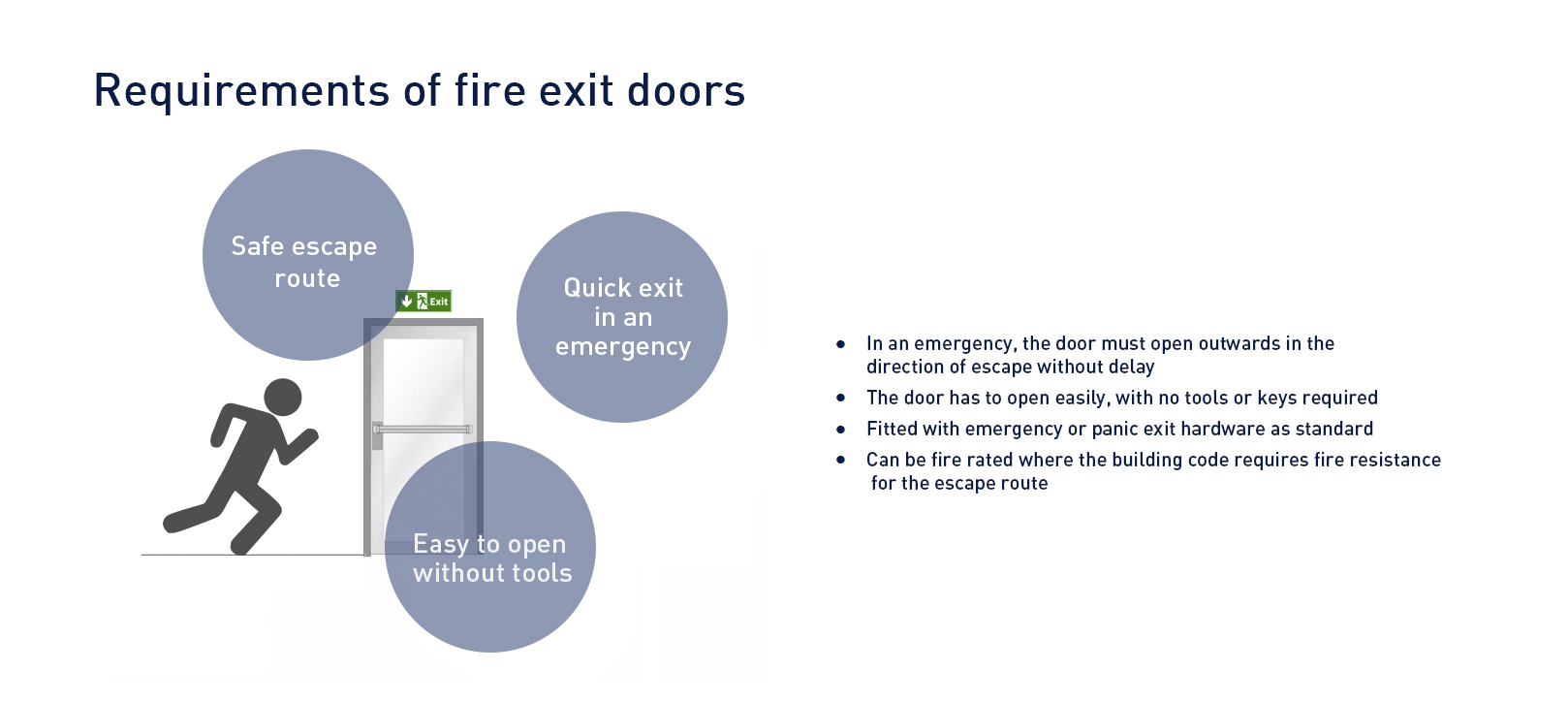
Although many types of locks and door hardware are used throughout a building, fire exit doors generally rely on two standardized exit solutions: EN 179 emergency exit hardware and EN 1125 panic exit hardware. The appropriate choice depends primarily on who uses the door and how the exit route is expected to function during an emergency.
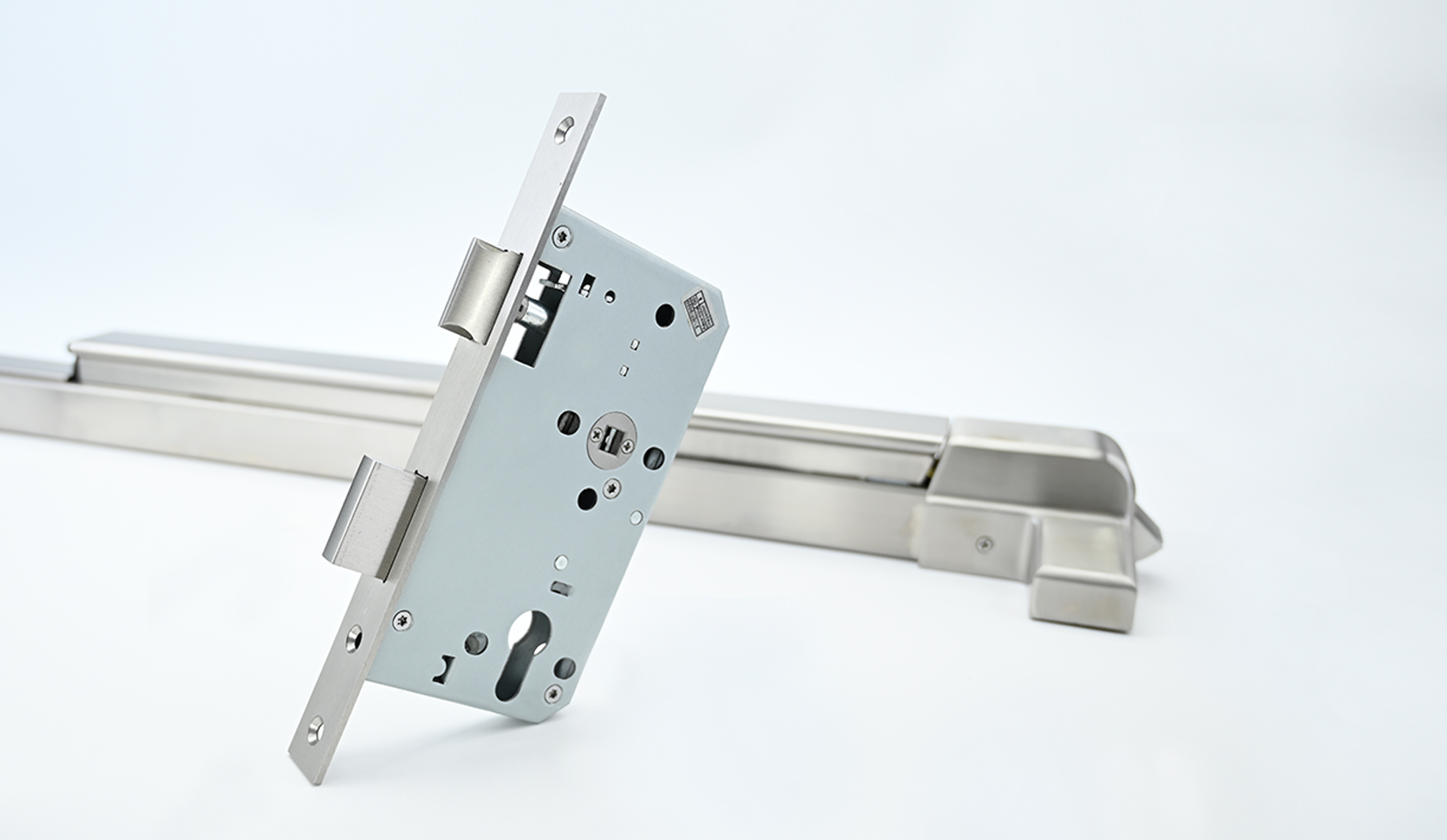
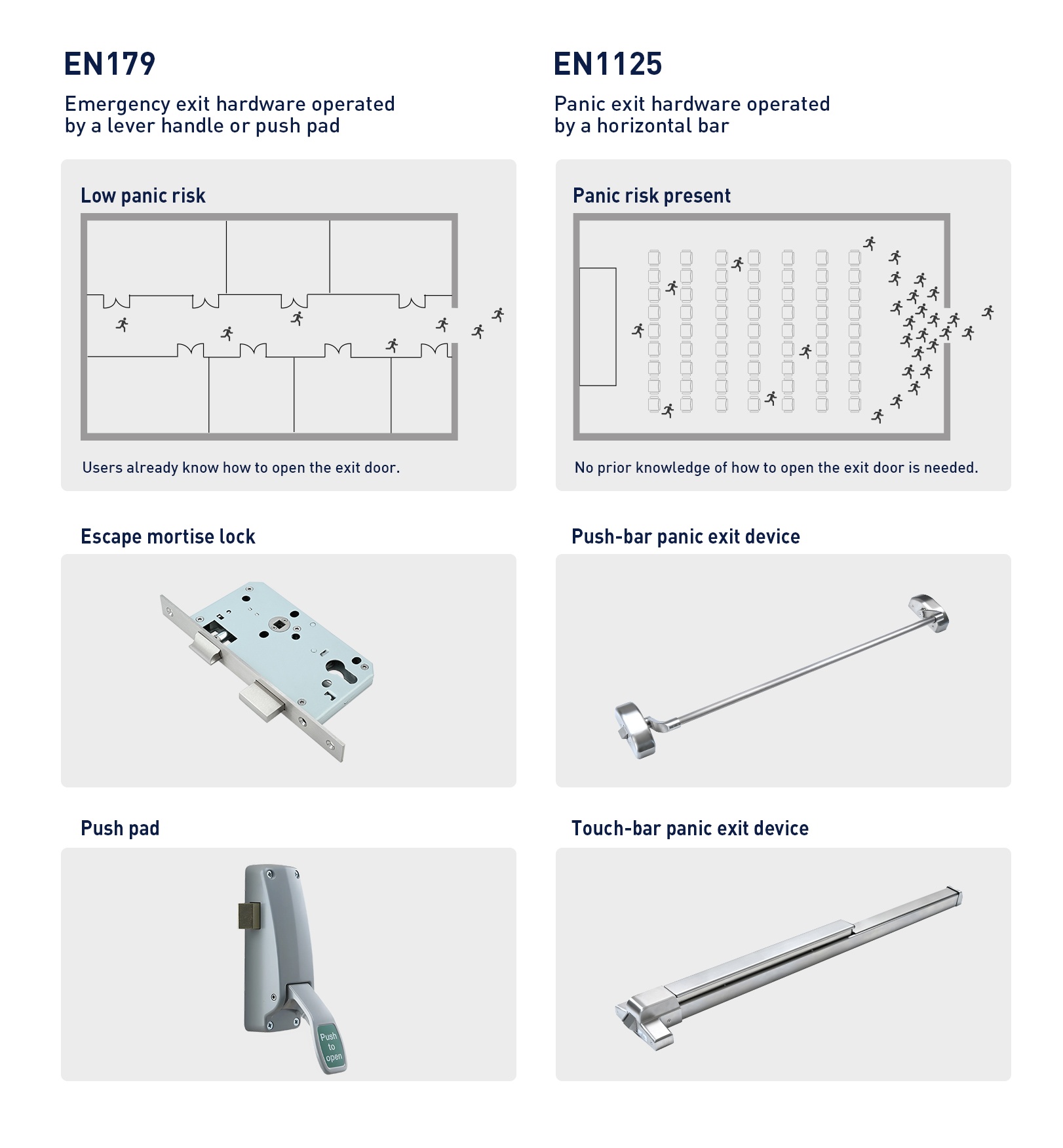
EN 179 covers emergency exit devices intended for situations where occupants are familiar with the building and its escape routes, and where mass panic is unlikely.
The standard assumes that users understand where the exits are located and how the hardware operates. As a result, the exit device may require a deliberate action, such as operating a lever handle or push pad, to release the door.
If crowd pressure on the door is anticipated during panic evacuation, EN 1125 panic exit hardware should be specified instead.
EN 179 hardware is commonly used in:
Office buildings
Industrial facilities
Warehouses
Staff-only areas
Plant rooms
Restricted-access commercial spaces
In these environments, occupants are generally trained, authorized, or familiar with the building layout.
Emergency exit hardware is designed to release the door with a single action from the escape side, without requiring a key or any other tool.
Common operating methods include:
Lever handles (with escape mortise locks)
Push pads
The objective is to provide reliable escape, regardless of any additional locking or unlocking devices such as deadbolts, while maintaining controlled access during normal building operation.
One of the most widely used EN 179 solutions is the escape mortise lock. Unlike surface-mounted exit devices, escape mortise locks are integrated within the door, providing a cleaner appearance while maintaining emergency egress functionality. They are widely specified for commercial and fire-rated door systems where aesthetics, security, and compliance must be balanced. For projects requiring EN 179 compliant escape solutions, escape mortise locks offer an effective combination of safety, functionality, and architectural integration.
Looking for EN 179 emergency exit hardware?
Explore our escape mortise lock designed for fire exit doors and commercial buildings →
EN 1125 covers panic exit devices intended for large public buildings where occupants may be unfamiliar with the escape route or where panic situations could occur.
The standard assumes that users may have little knowledge of the building layout and may need to evacuate quickly under stressful conditions. For this reason, the hardware must be operable by applying pressure anywhere along the actuating bar, with minimal force and without prior experience.
When the occupant capacity exceeds 60 persons, panic exit hardware is typically mandatory. The effective length of the bar shall be not less than 60% of the door leaf width.
EN 1125 hardware is commonly specified for:
Shopping centres
Schools
Hospitals
Airports
Sports venues
Cinemas
Public buildings
These environments often accommodate large numbers of visitors who may not be familiar with the building.
Panic devices allow the door to be released by simply pushing against the horizontal bar. This intuitive operation minimizes the need for prior knowledge or fine motor actions, helping occupants evacuate quickly during emergencies.
Typical EN 1125 products include:
Push bar devices
Touch bar devices
Vertical rod panic devices
The choice depends on door configuration, traffic volume, security requirements, and access control considerations.
Many panic hardware installations also require controlled access from the exterior side of the door. In these cases, outside access devices can be combined with panic hardware to allow authorized entry while maintaining emergency egress performance from the escape side. For projects involving public buildings and high-occupancy environments, panic hardware remains the preferred solution for achieving both life safety and regulatory compliance.
If there is uncertainty about the usage scenario or the occupant profile, it is recommended to default to EN 1125 panic exit devices.
Need EN 1125 Panic Hardware?
Explore our panic exit devices for public buildings and high-occupancy applications — visit us at www.dirock.com.cn.
Although both EN 179 and EN 1125 hardware are designed to enable safe evacuation, they address different occupancy scenarios and user behaviours.
The primary distinction lies in the expected users of the exit route.
Feature | EN 179 Emergency Exit Hardware | EN 1125 Panic Exit Hardware |
Intended Users | Occupants familiar with the building and escape routes | General public and occupants unfamiliar with the building |
Typical Buildings | Offices, factories, warehouses, staff-only areas | Shopping centres, schools, hospitals, airports, public venues |
Method of Operation | Lever handle, push pad | Push bar or touch bar |
User Knowledge Required | Users are expected to understand the escape route | No prior knowledge assumed |
Occupancy Type | Trained or authorized occupants | Large numbers of visitors or members of the public |
Typical Traffic Level | Medium to high | High to very high |
Common Products | Escape mortise locks, push pads | Push bar panic exit device, touch bar panic exit device, vertical rod devices |
Applicable Standard | EN 179 | EN 1125 |
In simple terms, EN 179 is generally used where occupants are familiar with the building, while EN 1125 is intended for environments where members of the public may need to evacuate quickly without prior knowledge of the exit system.
EN 179 / EN 1125 hardware vs standard door hardware
Not all door hardware is suitable for emergency or panic escape applications. Standard commercial locks and handles may provide security and access control, but they are not necessarily designed to support emergency evacuation requirements.
Comparison Item | EN 179 / EN 1125 Exit Hardware | Standard Door Hardware |
Core Function | Emergency (panic) escape + daily security | Daily security and general access |
Regulatory Compliance | Meets EN 179/1125 | No dedicated exit standard |
Operation | Single-handed, single action, no key required | Requires key/code/door handle |
Fire Door Compatibility | Suitable for use on fire doors; must be tested with the complete fire door assembly | Typically not certified for fire-rated use |
Application | Escape routes, fire doors | General rooms, residential use, non-escape paths |
CE Marking | Mandatory (Construction Products Regulation) | Depends on intended use |
For designated fire exits and emergency escape routes, hardware should always be selected according to the applicable regulations and building occupancy requirements.
Compliance is a critical consideration when specifying fire exit hardware. Certification provides independent verification that the hardware has been tested and assessed against relevant performance requirements. There are two European Standards:
EN 179 specifies the manufacturing, requirements and test methods for emergency exit devices operated by a lever handle or push pad.
EN 1125 specifies the requirements and test methods for panic exit devices operated by a horizontal push bar or touch bar.
Under the Construction Products Regulation (CPR), emergency and panic exit hardware covered by harmonized European standards may be CE marked when the applicable conformity assessment requirements have been fulfilled.
CE marking indicates that the product's declared performance has been assessed according to the relevant European requirements and that production is subject to ongoing factory production control.
When specifying fire exit lock, buyers should verify that the product is supported by appropriate certification and documentation from an accredited notified body where required.
Certification helps ensure that the hardware has been independently tested and evaluated for its intended application.
For architects, door manufacturers, contractors, and project specifiers, selecting certified products can help:
Support regulatory compliance
Simplify project approval processes
Reduce specification risks
Improve long-term reliability
When life-safety hardware is involved, certification should be viewed as a fundamental requirement rather than an optional feature.
Meeting EN 179 or EN 1125 requirements alone does not automatically mean that the hardware is suitable for every fire door application.
Fire doors are tested and assessed as complete assemblies, and the compatibility of each component must be considered. Whether exit hardware is suitable for fire door or smoke door assemblies must be verified through additional fire resistance testing.
Not necessarily. The suitability of exit hardware for a fire door depends on the specific door assembly, its fire rating, and the scope of the supporting test evidence. Exit devices and their accessories must pass EN 1634 testing for timber or steel fire doors, with test and certification reports issued by a third party notified body.
Before installing exit door hardware on a fire or smoke-control door, it is important to verify that the hardware is approved or tested for use with the intended fire door system, to ensure that its fire resistance rating matches that of the door assembly. Do not install exit hardware on a fire door assembly with a fire rating exceeding its certified scope.
Selecting between EN 179 and EN 1125 is primarily a matter of understanding the building, its occupants, and the intended use of the escape route.
The following decision process can help simplify specification.
This is usually the most important factor.
If the users are employees, trained personnel, or individuals familiar with the escape routes, EN 179 is often the appropriate solution.
Typical examples include offices, factories, warehouses, staff-only areas.
If the building is regularly used by visitors or members of the public, EN 1125 is generally required.
Typical examples include shopping centres, schools, hospitals, airports, entertainment venues.
Some exit doors are intended solely for emergency escape, while others may balance controlled entry from the outside with enhanced security needs.
Security level considerations
If basic access and standard security are sufficient, a single-point locking panic device is adequate. If the project demands enhanced anti-intrusion stability, a vertical rod panic device is recommended.
Vertical rod systems extend locking points to the top and bottom of the door leaf through a vertical linkage. When closed, the upper and lower bolts engage with the frame head and floor strike respectively, creating two locking points. Compared to single-point locking structures, this significantly improves overall resistance to forced entry. This configuration is suitable for public buildings, storage areas, or plant rooms where higher security levels are required.
External Access Function
Where external access is required, additional access devices or compatible locking arrangements may be necessary. The selected solution should maintain both security and emergency egress functionality.
Door configuration can influence hardware selection. Both EN 179 and EN 1125 exit door hardware must pass performance testing for single and double-leaf doors. This is specified in the classification digits of the respective standards:
Category A: outwardly opening single exit door, double exit door: active or inactive leaf;
Category B: outwardly opening single exit door only;
Category C: outwardly opening double exit door: inactive leaf only;
Category D: inwardly opening single exit door only.
Category A: single door, double door: active or inactive leaf;
Category B: single door only;
Category C: double door, inactive leaf only;
For double-leaf doors, dedicated hardware configurations are often required: single or multi-point horizontal latch devices on the active leaf, with vertical rod panic devices on the inactive leaf.
Fire exit door hardware plays a vital role in ensuring safe and efficient evacuation during emergencies. While both EN 179 emergency exit door lock and EN 1125 panic exit door lock are designed to facilitate escape, they are intended for different occupancy types and operating conditions.
In most cases, the selection process should follow three key steps: identify who uses the door; determine whether EN 179 or EN 1125 applies; verify compatibility with the complete fire door assembly. By selecting the appropriate standard and ensuring proper certification and door compatibility, project teams can improve safety, support regulatory compliance, and achieve reliable long-term performance.
For assistance with fire exit hardware selection, fire door hardware solutions, certification requirements, or project-specific applications, contact DIROCK team for further guidance.
Q1. What’s the difference between a fire exit door and a fire-rated door?
A fire exit door is installed on designated emergency routes to enable quick and safe evacuation during emergencies.
A fire-rated door undergoes fire resistance testing and can contain fire and smoke spread for a specified period, with fire integrity as its core performance indicator.
The key distinction lies in their primary functions: the fire exit door focuses on evacuation, while the fire-rated door prioritises fire resistance. Whether doors on escape routes require fire resistance is determined by building design and relevant fire safety regulations.
Q2. How can I reliably tell whether a door complies with EN 179 or EN 1125?
Check hardware type: EN 179 applies to lever handle or push pad operated devices, while EN 1125 covers horizontal push bars and touch bars.
Check product markings: compliant products shall be marked with the manufacturer’s name, 10-digit classification code and CE marking.
Verify certification documents: review the accompanying Dop and CE certificates to confirm usage class, durability rating and fire compatibility.
Q3. Can I install exit door hardware on any fire door?
No. Exit hardware must be fire-tested as part of the specific door assembly (e.g., EN 1634-1), and its fire rating must not exceed the certified scope of the door leaf. Before installation, verify that the hardware has passed fire resistance testing for the corresponding door type (timber or steel).
