
Views: 0 Author: Site Editor Publish Time: 2026-08-15 Origin: Site

Fire doors are a key part of passive fire protection systems. However, a door cannot be considered fire-resistant simply because it is made from steel, fitted with fire-rated hardware, or described as "60-minute rated" in a product catalogue. Its fire performance must be supported by evidence from a standardized test. In Europe, EN 1634-1 is one of the main standards used to determine the fire resistance of door and shutter assemblies, openable windows.
EN 1634-1 evaluates the performance of a tested door or closure assembly under controlled fire exposure. The result is then used to determine whether the assembly can maintain integrity, insulation, or radiation-control performance for a specified period.
Understanding EN 1634-1 helps architects, door manufacturers, specifiers, and hardware suppliers correctly evaluate fire door performance and select suitable components for compliant fire door systems.
| Question | Explanation |
| What does EN 1634-1 test? | Door and shutter assemblies, openable windows. |
| Is it a test method or product certificate? | It is primarily a fire-resistance test method. |
| What is tested? | The complete assembly, including the door leaf, frame, seals, hardware, glazing (where applicable), and installation conditions. |
| How are results expressed? | Through classifications such as E30, EI60, or EW60. |
| Does it test smoke leakage? | Smoke control generally requires a separate EN 1634-3 test. |
| Can the result apply to every similar door? | No. The result is limited by the tested configuration and permitted application rules. |
EN 1634-1 establishes a controlled procedure for exposing a door or closure assembly to fire and recording its performance over time.
The standard can apply to several types of products, including:
Hinged and pivoted doors
Horizontally or vertically sliding doors
Folding and sliding-folding doors
Rolling shutters
Tilting doors
Openable windows
Operable fabric curtains
The purpose is to determine how long the tested assembly can prevent the spread of fire and, where required, limit heat transfer or thermal radiation to the unexposed side. EN 1634-1 is used together with EN 1363-1, which provides the general principles and conditions for fire resistance testing.
EN 1634-1 is a test method, not a universal product label
One of the most important points is that EN 1634-1 should not be treated as a universal certification label.
The standard defines: test conditions, test specimen requirements, furnace exposure, measurement methods, performance criteria, test duration, permitted changes to the tested specimen. The test data may then be used for classification under EN 13501-2. EN 13501-2 provides the classification procedure for construction products and building elements based on fire-resistance and smoke-control test data.
Therefore, the correct interpretation is not simply "this product has EN 1634-1 certification." The more accurate interpretation is: This product was tested according to EN 1634-1 and achieved a defined fire performance under the stated conditions.
The applicable product standard, classification document, declaration, certification route, and local building regulations may also need to be reviewed.
Testing under EN 1634-1 is conducted on complete door or shutter assemblies, not on individual components in isolation. The tested specimen typically includes the door leaf and frame, hinges, locks, door closers, handles, cylinders, and exit hardware. Before fire exposure begins, the specimen is conditioned and then installed into a standard or associated supporting construction that represents its intended end-use. The laboratory verifies construction details, inspects the specimen, and instruments it with thermocouples before testing commences.
The assembly is then exposed to the standard time-temperature fire curve in accordance with EN 1363-1. During the test, the laboratory monitors and records furnace temperature, pressure conditions, surface temperatures, visible flames, openings or cracks, deflection, and thermal radiation where applicable. The specimen is evaluated against the three performance criteria of integrity, insulation, and radiation.
The test continues until a required performance criterion fails, the test target duration is completed, or the laboratory or test sponsor stops the test for a defined reason. If the assembly fails before the target duration, the final classification cannot normally exceed the time at which the required criterion was lost.
Results are compiled in a comprehensive test report covering specimen details, measurement data, observations, failure times, and the achieved fire-resistance performance.
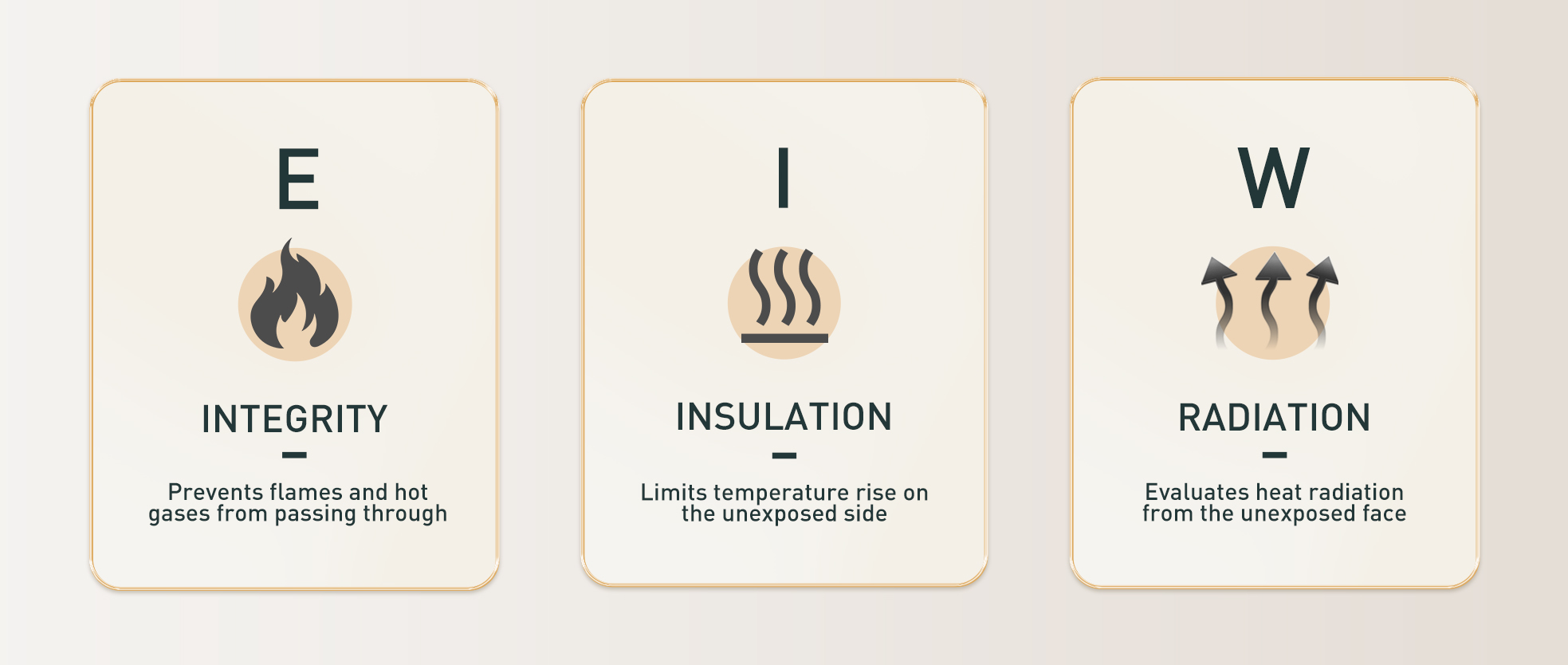
The main fire-resistance criteria used for door assemblies are integrity, insulation, and radiation.
Integrity (E): Integrity refers to the ability of the door assembly to prevent flames and hot gases from passing from the exposed side to the unexposed side.
Insulation (I): Insulation refers to the ability of the assembly to limit temperature rise on the unexposed side within the permitted limits. Insulation is important when people, combustible materials, escape routes, or sensitive equipment may be located close to the protected side of the door.
Radiation (W): Evaluates heat radiation radiating from the unexposed face of the tested assembly (tested as required).
| Classification | Meaning |
| E30 or E60 or E90 or E120 | Integrity only, for 30 or 60 or 90 or 120 minutes |
| EI30 or EI60 or EI90 or EI120 | Integrity and insulation, for 30 or 60 or 90 or 120 minutes |
| EW30 or EW60 or EW90 or EW120 | Integrity and limited radiation control, for 30 or 60 or 90 or 120 minutes. |
Several international fire resistance standards may appear together in fire door specifications.
| Standard | Main purpose |
| EN 1634-1 | Fire-resistance test for door and shutter assemblies and openable windows |
| EN 1363-1 | General principles and conditions for fire-resistance testing |
| EN 13501-2 | Classification of construction products and building elements using test data |
| EN 1634-2 | Fire-resistance characterisation test for elements of building hardware |
| EN 1634-3 | Smoke-control test for door and shutter assemblies |
| UL 10C | American fire test standard for fire door assemblies |
How does EN 1634-1 relate to fire door hardware?
Fire door hardware plays an important role in the overall performance of a tested fire door assembly. Although hardware components have their own relevant product standards, their performance must be considered together with the complete fire door configuration. Important hardware elements may include: mortise locks, hinges, door closers, profile cylinders, lever handles, exit hardware.
European standards for building hardware adopt a multi-digit classification system, with each digit representing a specific performance characteristic against standardized requirements; the fourth digit relates to the fire resistance performance of the product and its suitability for use on fire and smoke control doorsets.
For example: EN 12209 defines requirements and classifications for mechanically operated locks and latches. Additional fire performance evidence is required for locks intended for use in fire and smoke control doorsets. Four grades are identified:
Grade 0: not verified for use on fire-resisting/smoke-control door set assemblies;
Grade A: for use on smoke-control door set assemblies based on a test in accordance with EN 1634-3;
Grade B: for use on smoke control and fire resisting door set assemblies based on a test in accordance with EN 1634-1 or EN 1634-2;
Grade N: for use on smoke control and fire resisting door set assemblies based on tests where the lock does not contribute to keeping the door in a closed position during the fire resisting and/or smoke control test.
The final suitability of hardware depends on the tested door configuration, applicable standards, and project requirements.
Fire doors are installed in walls and openings that are intended to separate parts of a building. A tested doorset helps maintain that separation when exposed to fire. If the door, frame, seals, or hardware fails prematurely, fire and hot gases may spread between compartments faster than expected.
A fire-resistant door can help protect corridors, stairwells, and other escape routes for a specified period. However, this protection is only achieved when the doorset is correctly specified, installed, and maintained as tested.
EN 1634-1 testing gives architects, contractors, door manufacturers, and building owners a common basis for reviewing fire performance. It helps prevent decisions based only on product appearance, material description, unit price, generic "fire-rated" claims, unverified supplier statements.
Replacing a lock, hinge, handle, cylinder, closer, seal, or glazing component may change the tested assembly. This is particularly important when hardware is supplied by different manufacturers. The replacement product must be supported by appropriate evidence and must be compatible with the tested doorset.
EN 1634-1 provides the technical basis for demonstrating fire-resistance under construction product regulations. The resulting classification is typically required for building control approval and CE marking of fire-rated door assemblies.
A complete test report and classification document can support technical submissions, installation control, and future inspection. For commercial projects, clear documentation also helps maintain consistency when multiple doorsets are produced in different batches or installed across different areas.
EN 1634-1 provides a test method. The final classification, certification, declaration, and market approval may involve additional standards and procedures.
A fire-tested lock or handle does not automatically prove that every complete door assembly will achieve the same rating. The complete door construction and hardware combination must be considered.
Even a small change to the lock case, handle, cylinder, closer, or fixing method may affect fire performance.
E, EI, and EW describe different performance criteria. An E-rated door should not be specified where insulation is required unless the correct EI evidence is available.
Fire resistance and smoke leakage are related but different performance characteristics. Smoke-control requirements normally require additional testing under EN 1634-3.
A doorset may fail to perform as tested if it is installed with the wrong frame, fixing, seal, wall construction, or hardware preparation.
A test result for a timber fire door cannot automatically be applied to a steel fire door. Permitted variations must be supported by direct or extended application rules.
EN 1634-1 provides a standardized method for evaluating the fire resistance performance of door, shutter, and openable window assemblies. Its importance lies in demonstrating how a specific tested configuration performs under fire exposure conditions.
For fire door projects, compliance depends not only on individual components but also on the compatibility of the complete assembly, including the door construction, hardware, installation method, and supporting documentation.
For European-standard fire door hardware solutions, DIROCK provides EN-compliant fire-rated mortise locks, stainless steel lever handles, euro profile cylinders, hinges and technical support to help buyers review all relevant certificates and documentation, ensuring compatibility with their project-specific door configuration.
We're here to support your projects.
Contact our experts to discuss your project's needs and let us help you ensure the compliance and safety of your building.
Email us at: biz@dirock.com
