
Views: 0 Author: Site Editor Publish Time: 2026-09-14 Origin: Site
This European standard specifies performance requirements and test methods for single-axis hinges for doors and windows, covering both lift-off and fixed-pin types. For use on fire/smoke door assemblies, single-axis hinges must be tested to EN 1634-1 for fire resistance, in addition to the tests specified in this standard; the annex to this standard sets out additional requirements for such products.
BS EN 1935:2002 classifies hinges using an 8-digit coding system. Each digit represents a specific performance characteristic: category of use, durability, test door mass, fire resistance, safety, corrosion resistance, security, and hinge grade. Each characteristic is tested and rated against the requirements of the standard. This classification system helps specifiers select hinges appropriate to the intended application.
Four categories of use are identified for hinges.
Grade | Category | Core criteria | Typical applications |
1 | Light duty | Low frequency of use; users with a high incentive to exercise care; small chance of accidents or misuse | Internal domestic doors; offices and areas with no access by the general public |
2 | Medium duty | Medium frequency of use; users with some incentive to exercise care; some chance of accidents or misuse | Domestic and other situations: offices and areas with limited access by the general public |
3 | Heavy duty | High frequency of use by the public or others with little incentive to exercise care; high chance of accidents or misuse | Public and institutional buildings such as hospitals |
4 | Severe duty | Frequent violent usage | Areas with high risk of deliberate abuse or violent attack |
Three grades are identified for hinges manufactured to this European standard:
Grade 3: 10 000 test cycles, intended for use only on windows
Grade 4: 25 000 test cycles, intended for use on windows and doors
Grade 7: 200 000 test cycles, intended for use only on doors
Eight door mass grades are identified:
Grade 0: up to 10 kg
Grade 1: up to 20 kg
Grade 2: up to 40 kg
Grade 3: up to 60 kg
Grade 4: up to 80 kg
Grade 5: up to 100 kg
Grade 6: up to 120 kg
Grade 7: up to 160 kg
Two grades are identified:
Grade 0: not suitable for use on fire resistant and/or smoke control door assemblies;
Grade 1: suitable for use on fire/smoke resistant door assemblies subject to satisfactory assessment of the contribution of the hinges to the fire resistance of the specified fire/door assemblies.
Single-axis hinges are required to satisfy the essential requirement of safety in use. Therefore, only grade 1 is identified.
Five grades of corrosion resistance are identified according to EN 1670:
Grade 0: no defined corrosion resistance
Grade 1: mild resistance, 24h
Grade 2: moderate resistance, 48h
Grade 3: high resistance, 96h
Grade 4: very high resistance, 240h
Two grades of security are identified for hinges:
Grade 0: not suitable for use on burglar-resistant door assemblies;
Grade 1: suitable for use on burglar-resistant door assemblies.
Fourteen grades of hinge are identified in this European standard, as listed in the table below.
Hinge grade | Application | Durability test cycles | Test door mass |
1 | Window | 10 000 | 10 kg |
2 | Window | 10 000 | 20 kg |
3 | Window/Door | 25 000 | 20 kg |
4 | Door | 200 000 | 20 kg |
5 | Window | 10 000 | 40 kg |
6 | Window/Door | 25 000 | 40 kg |
7 | Door | 200 000 | 40 kg |
8 | Window | 10 000 | 60 kg |
9 | Window/Door | 25 000 | 60 kg |
10 | Door | 200 000 | 60 kg |
11 | Door | 200 000 | 80 kg |
12 | Door | 200 000 | 100 kg |
13 | Door | 200 000 | 120 kg |
14 | Door | 200 000 | 160 kg |

Classification code: 4 7 6 1 1 4 0 13
Explanation:
4: Severe duty use
7: 200 000 durability test cycles
6: Test door mass up to 120kg
1: Suitable for fire/smoke compartmentation door assemblies
1: Safety approved
4: 240h corrosion resistance
0: Not suitable for use on burglar-resistant door assemblies
13: Hinge grade 13
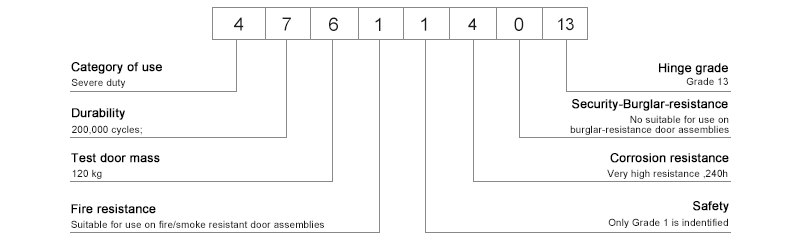
This classification is representative of CE-marked fire door hinges specified for public and commercial buildings. If you are sourcing door hinges for fire doors, browse the DIROCK hinge range.
When specifying single-axis hinges for construction projects, the EN 1935 8-digit coding system provides objective, test-based performance data rather than relying solely on material, dimensions, or appearance. This classification system offers a clear, standardized method for verifying hinge key performance characteristics—from durability and test door mass to fire resistance and corrosion resistance.
Understanding this coding system helps architects, contractors, and door manufacturers make informed selections, mitigating project risks caused by specification errors and ensuring hinge performance is precisely matched to on-site application requirements.
